
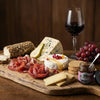
How to Make a Cheese and Charcuterie Board
, by Online Cheesemonger, 6 min reading time
, by Online Cheesemonger, 6 min reading time
Build a balanced cheese and charcuterie board with contrasting cheeses, cured meats, oatcakes and condiments, plus practical portion and serving advice.
A cheese and charcuterie board works best when each part has a purpose. Cheese gives you contrasting textures, cured meats add savoury depth, and fruit, pickles and oatcakes provide balance. You do not need a huge table or an elaborate arrangement to make the result feel generous.
Start by deciding whether you are serving a few nibbles, a light meal or part of a larger buffet. That decision affects the quantity more than the size of the wooden board. Our cheese range and meats and charcuterie give you the building blocks.
For drinks before dinner, keep portions modest and make the food easy to pick up. For lunch, add enough bread, crackers and other food to make a satisfying meal. At a larger party, several smaller platters are often easier to reach and replenish than one densely packed centrepiece.
Ask about dietary requirements before choosing the selection. If some guests avoid meat, prepare their cheese and accompaniments separately with dedicated utensils. Vegetarian suitability also depends on the cheeses and condiments chosen, so check the current product labels rather than assuming a meat-free board suits everyone.
Think about practical space as well: you need somewhere for plates, napkins and knives, not just food. Leave room around soft cheeses for cutting and around bowls for spoons. A board people can use comfortably is more successful than one that looks full but is awkward to eat from.
A firm cheddar, creamy Brie and characterful blue cheese make an easy starting trio. They offer clearly different textures without requiring a large number of products. Change one style if you know your guests have a strong preference.
For a Scottish selection, consider Isle of Mull Cheddar, Morangie Brie and Arran Blue. Check the current sizes and descriptions when ordering, then choose quantities that fit your guest list.
You can add another soft or smoked cheese for a larger gathering, but avoid several cheeses doing the same job. A board of six similar firm cheeses may offer less useful contrast than three distinct styles. Let variety come from flavour and texture, not just the number of labels.

Choose two or three meat styles with a clear difference between them, such as sliced salami and a smoked or cured meat. Our charcuterie collection includes Scottish venison options and other savoury choices. Read each listing carefully: products in a broad meat collection are not all ready-to-eat charcuterie.
The Great Glen Charcuterie Board is a convenient option to explore. Check its current contents and storage instructions, and compare the amount of meat with the rest of your menu. A product photograph does not replace reading the pack weight.
Arrange sliced meats loosely so they are easy to lift. You do not need intricate folds or tightly packed roses. Separate different types into small groups, keeping them away from cheeses reserved for vegetarian guests. Use utensils where appropriate and follow each product's preparation guidance.
Scottish oatcakes and biscuits provide a crisp base for both cheese and meat. Offer a plain option even if you include something seasoned. Strong chilli or garlic biscuits can dominate a delicate cheese and make every bite taste similar.
Choose one or two chutneys or pickles for contrast. A fruit or onion chutney can add sweetness, while a sharper pickle gives a different effect. Keep them in small bowls with separate spoons so the board remains tidy and guests control the balance.
Fresh fruit can make a rich selection feel lighter. Grapes, apple or pear are easy options; prepare fruit hygienically and keep juicy pieces away from crackers. Nuts are optional and are best served separately, especially when guests need clear allergen information.
For cheese as part of a substantial grazing meal, 100–150g per adult can be a starting range, adjusted for appetite and other food. If the board is only a small course or one of many buffet dishes, buy less. The amount is total cheese per person, not that amount of every variety.
Plan charcuterie separately. Around 40–60g per adult can be a loose starting point when it accompanies cheese and other foods, but the right quantity depends on whether meat is a small extra or a main element. Check actual pack sizes and build a sensible total rather than multiplying every component independently.
For a worked calculation, see our cheese portion guide. Buying a little reserve can help with uncertain guest numbers, provided you have a plan for storing and using it. It does not all need to be placed on the board at once.
Place the cheeses first, leaving cutting space and a knife for each. Add condiment bowls next, then small groups of charcuterie. Finish with fruit and a modest number of crackers, keeping extra biscuits in a separate basket where they remain dry.
Use labels if guests may not recognise the cheeses or meats. Keep original packaging nearby for ingredient checks. A short label with the product name is more helpful than an elaborate decoration that makes serving harder.
For longer gatherings, replenish smaller portions from the fridge and keep chilled foods out for the shortest practical time. Follow the labels and use-by dates. The Food Standards Agency's chilling guidance explains safe storage; a grazing board should not mean leaving perishable food out all evening.
Three contrasting styles are enough for many small gatherings. Add another only if it introduces a useful difference or suits a known guest preference.
Two different styles can provide plenty of contrast. Focus on quality, pack size and what your guests enjoy rather than opening a large number of similar products.
You can plan the layout and prepare suitable components ahead, but keep chilled items refrigerated until needed. Add crackers close to serving and follow each food's storage instructions.
Use a separate platter and utensils, choose cheeses labelled suitable for vegetarians, and check accompaniments too. Simply moving meat to the other side of a shared board may not meet a guest's needs.
Browse the Cheese, Condiment and Charcuterie Gift Set. Check the current contents, weights and delivery information to decide whether it suits your occasion.